Day 4, our group left for Blue Eye in southern Albania. Blue Eye is a water spring and natural phenomenon in a river with crystal clear blue water from the
surrounding mountains, with Blue Eye having of depth of more than fifty metres. Divers have descended to fifty metres, but never hit bottom, so it is still unclear what
the actual depth of the hole is.
After Blue Eye we drove towards the coastal resort city of Sarandë, but first made a stop at the Church of the Monastery of Saint Kolli (Mesopotam). Built in 1224, the outside is
still in excellent shape, but the insides are badly worn, with remaining frescoes badly faded or chipped away and even worse, most walls were painted over by the communists because
they used it as a storage facility when they banned all forms of religion in 1976. In Abiori Restaurant Pizzeria in Ksamil, just south of Sarandë, the group went to the most upscale
restaurant of the trip, with a great view of the Ionian Sea, and the squid was quite good. On this trip, "lunch" was the main meal of the day ... dinner was on our own and usually
something small or dessert-like.
After lunch, the group visited the ruins of the ancient city of Butrint, inhabited by various groups since prehistoric times. Walls from the Illyrian period around the 7th century BC
are still visible in the main part of the city ruins. The Greeks settled here shortly after and didn't conquer but worked with the Illyrians, but the city grew when the Romans
conquered the area and took over around 40 BC. In the first century AD, an aqueduct was constructed to bring water to the city, and the theater, baths and the temple of Asklepios
(god of medicine and healing) was built. In the 2nd century AD, a nymphaeum and a gymnasium near the Tower Gate were added. Homes and extravagent villas were built all the way out
to the Vivari Canal. In Late Antiquity (250-750 AD), Butrint experienced a period of expansion and prosperity, during which the reconstruction of the defensive walls damaged over
the years was carried out. The baptistery was built in the middle of the 5th century. The Basilica of the Acropolis was built at the end of the 4th century and was paved with
mosaics (which are only uncovered for a few weeks in the summer dry period). The quite imposing Great Basilica was built in the lower city in the 6th century. Much of the walls
that surrounded the city still are standing, and often are part Illyrian, part Greek and part Roman. The city thrived and was well occupied until the early Middle Ages.
Later the Venetians purchased Butrint in 1386, then built a tower and the Acropolis Castle on the highest point of Butrint. Across the canal, they built the Venetian Triangular
Castle in the 15th century. After centuries of pretty much constant conflict with the Ottomans, Butrint came under Ottoman control in the late 18th century. But it was abandoned
by the early 19th century, gradually transforming into a small fishing village.
To end the day it was a light snack and sunset in Sarandë.
|
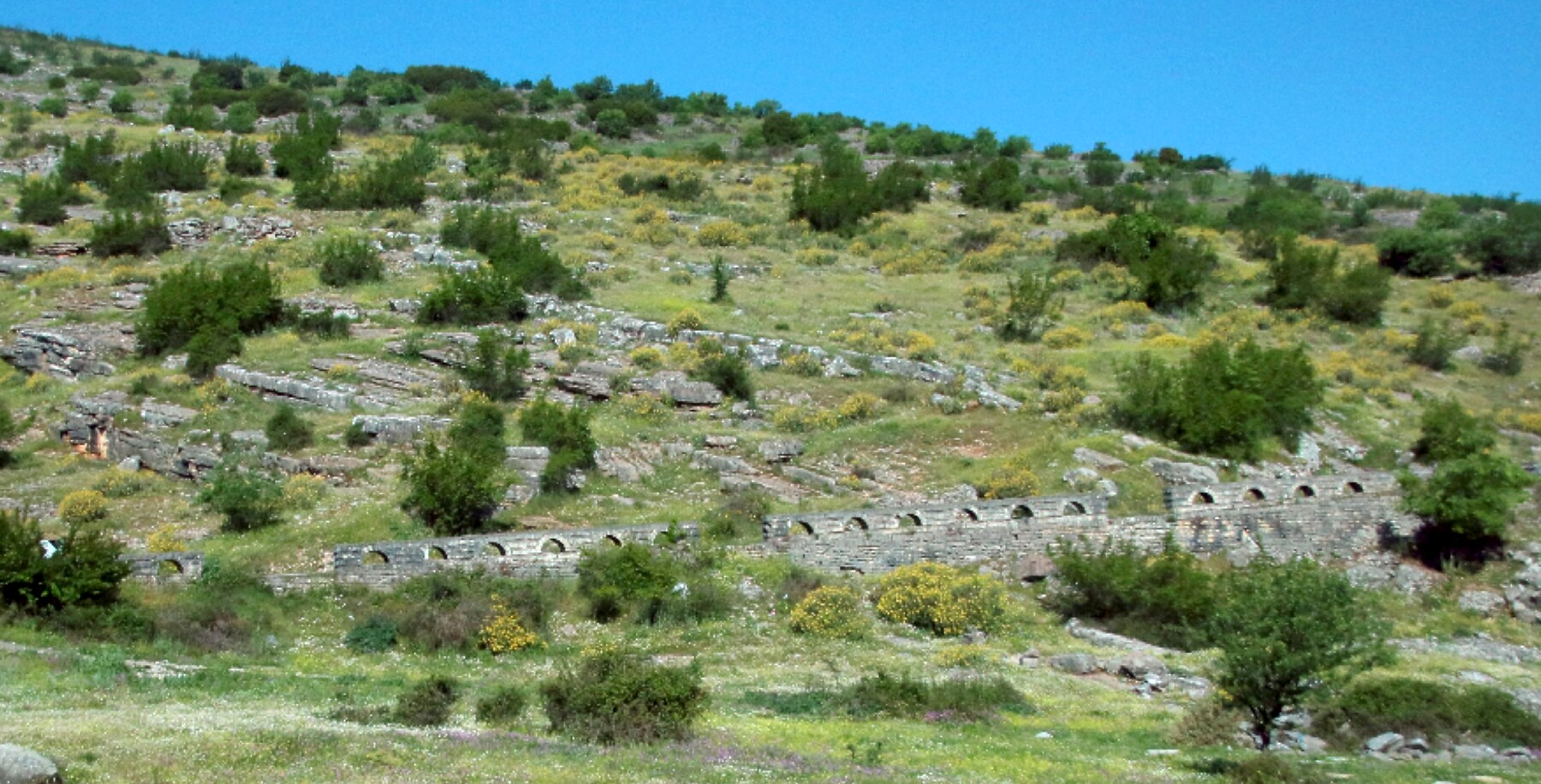
Above: Driving through the Albanian countryside to get to the Blue Eye park, an ancient Roman wall on a hill still stands pretty much intact.
|
|


