Paracas, Peru
September 25, 2026
|
On Day 9 ... after a beautiful sunset and barely a cloud in the sky the day before, we woke up to a misty and cloudy morning. We hustled ourselves from the hotel about 200 feet to
the Paracas dock, to join a packed boat tour of the Islas Ballestas Paracas. It's a group of islands in the Pacific Ocean off the coast near Paracas, sometimes called the "Poor Man's
Galápagos" because the islands are covered with wildlife ... Humboldt penguins, guanay and red-legged cormorant, Peruvian booby, Peruvian pelican, Inca terns and Sea Lions. There are
so many birds and sea lions that piled-up guano (manure) provides a nutrient-rich organic fertilizer that has been exploited throughout Peruvian history and agriculture for thousands
of years. Guano is a sticky mixture of seabird excrement, feathers, eggshells, and bones left by millions of birds. Because there is little rainfall, water does not wash away the
high levels of nitrogen, phosphorus, and potassium. In some years in the late 1800's, Guano earned 80% of the country's tax revenue, and Spain and Peru went to war over it.
After getting back from the boat tour, the group drove to The Paracas National Reserve (Reserva Nacional de Paracas), a protected desert and marine ecosystem near the village of
Paracas and the town of Pisco. Established on September 25, 1975, it spans approximately 3,350 square kilometers (over 800,000 acres), with roughly two-thirds of the territory
consisting of marine habitat (which includes Islas Ballestas, and El Candelabro (The Candelabra), a giant prehistoric geoglyph).
In the evening, six of our group enjoyed fresh seafood at Puerto Ballestas Restaurant ... pour moi, delicious grilled Octopus, asparagus and potatoes, with a couple of Pisco Sours.
|
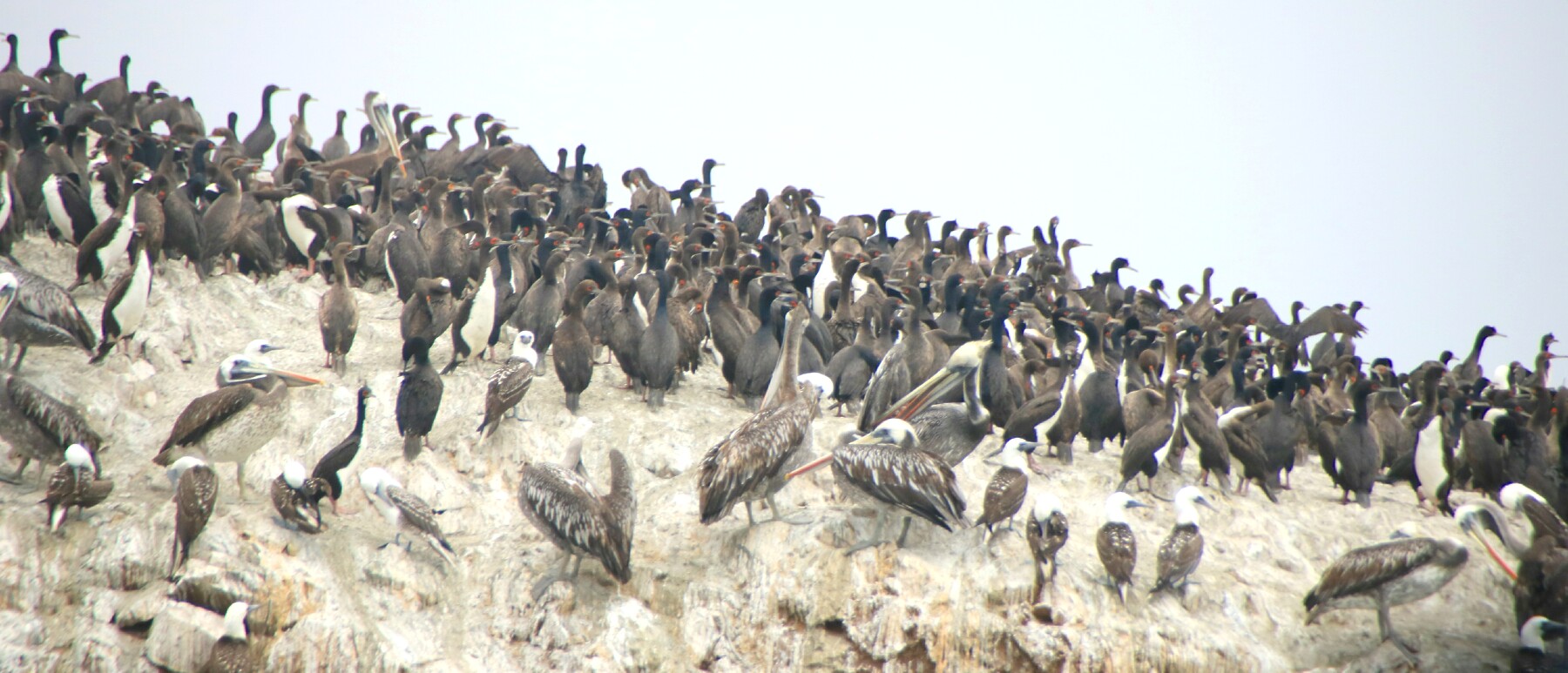
Above: On the peninsula near Paracas, the edge is thick with wildlife ... Boobies, Cormorants and Peruvian Pelicans.
|
|


