Cusco, Peru
September 22, 2026
|
On Day 6, it was the day we were all waiting for ... the trip to Machu Picchu. After a 5 am wakeup and a quick breakfast, we took the slow, bumpy road to the train station in
Ollantaytambo. Our tickets said 7:15 am, and the bus was taking its sweet time getting there, other vehicles passing on the atrocious road. Our vehicle arrived about 7:25, but the
train was still sitting there ... turns out in the fine print on the ticket it says the train actually leaves at 7:45 am, we're just supposed to be there a half hour early.
The eventual train ride through the valley along the Urubamba River took about 1.5 hours to get to the little village of Machu Picchu.
Once in the village, we lined up to get on a bus up the mountain to the entrance to Machu Picchu. People were allowed to walk up the very high mountain in the thin air, but no sane
person would, and we saw nobody attempting it. The top of the Machu Picchu mountain is just above 2400 metres sbpve sea level ... lower than Cusco by about 1000 metres, but the air
is still thin. There are 3 circuits that visitors can select upon booking. 3 of us went on Circuit 1, which primarily features a hike up to the lookout point for the iconic photo
of Machu Picchu. The remaining 5 of us, including moi, went on Circuit 3, which involves an up and down trek through the homes and building ruins in the lower parts of Machu Picchu.
Machu Picchu has been nicknamed the "Lost City of the Incas". It was built around 1450 AD, and believed to have served as an estate for the Inca emperor Pachacuti, after his conquest
of the middle and lower Urubamba. The site was abandoned roughly a century later during the Spanish conquest without a confrontation with the Spanish. Radiocarbon dating places its
occupation between 1420 and 1530 AD. The city was constructed in the Inca style, featuring finely crafted dry-stone walls. During its use as an estate, it is estimated
that up to 750 people were living there, with most serving as support staff who lived there permanently. Religious specialists and temporary specialized workers lived there as well,
most likely for the ruler's well-being and enjoyment. During winter, staffing was reduced to a few hundred servants and a few religious
specialists focused on maintenance. Studies of skeletal remains found at Machu Picchu show that most people who lived there were immigrants from diverse backgrounds.
Animals were also brought to Machu Picchu, with several bones found that were not native to the area. Most animal bones found were from llamas and alpacas. Guinea pigs were also
found at the site in special tomb caves, suggesting that they were at least used for funeral and sacrificial rituals, as was common throughout the Inca Empire, and also for their
meat. The Temple of the Condor was one of the main places for animal sacrifice. Six dogs were recovered from the site, found among the human remains. It is believed that they
served as companions of the dead. Much of the farming carried out at Machu Picchu was done on its andenes (artificial terraces). These terraces were well engineered, built to
ensure drainage and soil fertility while also protecting the mountain itself from erosion and landslides. But there is evidence landslides still happened. Studies of the soil show
mostly corn and potatoes were grown. But with only 12 acres of farming land in Machu Picchu, food had to be imported from the surrounding valleys. It wasn't just animals that were
found ... human remains of 174 individuals have been found in the 104 caves in the surrounding area.
After coming back down the mountain, our group had an excellent lunch, which may or may not have involved a Pisco Sour. At around 4:30 pm, the group took the train ride back to
Ollantaytambo, which lasted around 3 hours instead of 1.5, because another train went off the tracks, and we sat around and waited. And waited. And waited. Eventually, the train
arrived at its destination, and the group got in the van and got into Cusco and our hotels around 10 pm. But, pour moi, the best day on the trip.
|
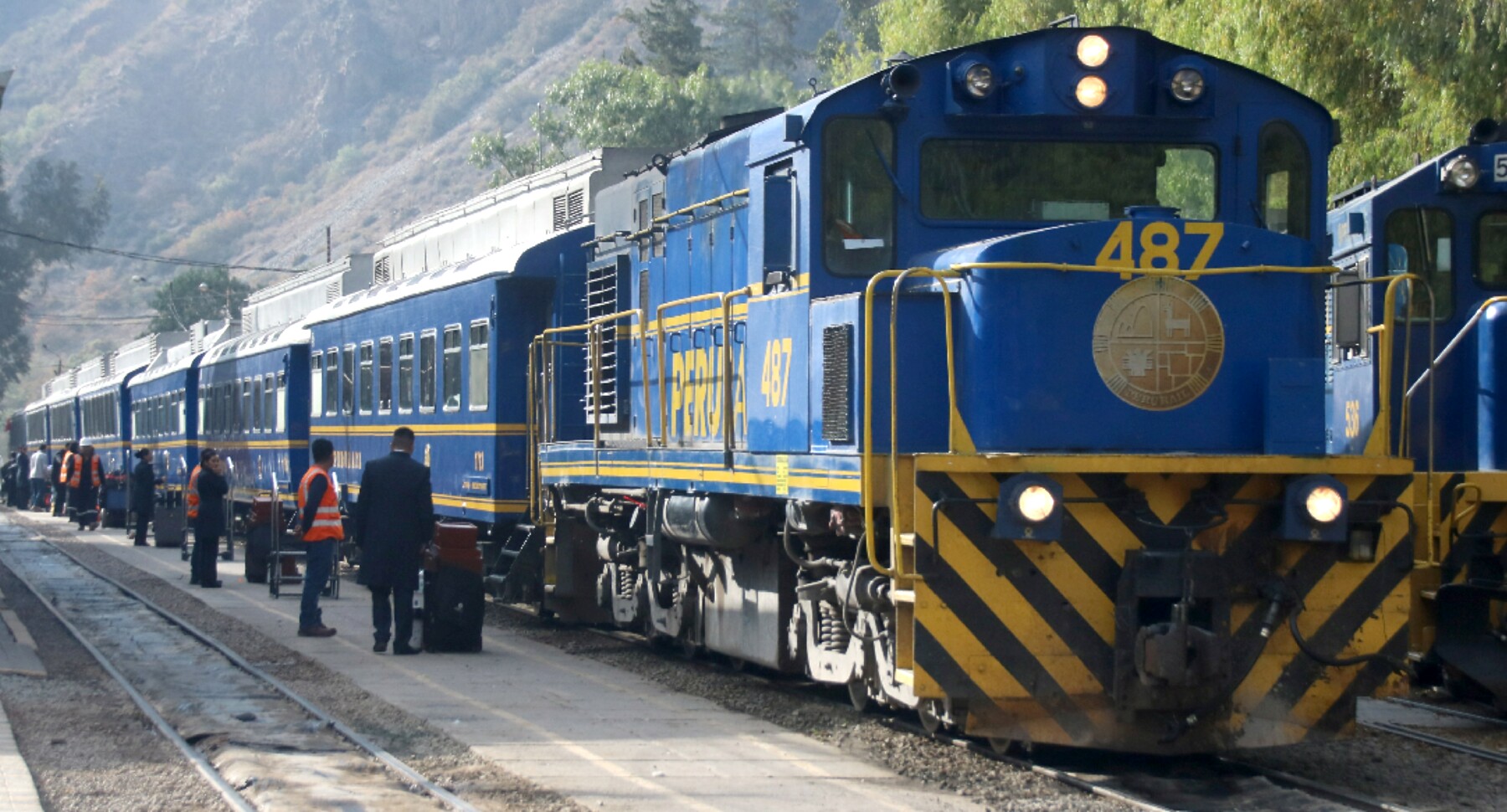
Above: The Peru Rail train taking us all to Machu Picchu, leaving at 7:45.
|
|


