Cusco, Peru
September 21, 2026
|
On Day 5, the group got up nice and early for a trip into the Sacred Valley of the Incas (Urubamba Valley), a lush agricultural and historical corridor in the Andes of Peru.
It stretches along the Urubamba River between Cusco and Machu Picchu. We started off at another farm, this time with a weaving and dyeing demonstration, and some cute and furry
guinea pigs. And of course, there was a store with lovely alpaca fur products for sale, plus jewelry.
Next was a stop at the ancient Incan village of Chinchero, nestled among the mountains. The people that live in the district are mainly indigenous citizens of Quechua descent, with the
native Quechua the language which the majority of the population (over 80%) learnt to speak in childhood. Many goods and foods are still made and sold by Indigenous traditions.
The van finally reached the central town in the Sacred Valley, Urubamba, where we would later stay the night. Speeding through the town, our group arrived at Ollantaytambo.
Human occupation on the site is believed to date back as far as 3,500 years. Some buildings here date to well before the time of the Incas, who conquered it in the mid-15th
century. Evidence of settlements of the Huari civilization (600 – 1000 AD) remain. Ollantaytambo controlled access to what later became known as the Inca Trail. Around the
mid-15th century, the Inca emperor Pachacuti conquered and razed a pre-existing town of Ollantaytambo, and the town and the nearby
region were incorporated into his personal estate. He rebuilt it with luxurious constructions and extensive works of terracing and irrigation in the
Urubamba Valley. The town provided lodging for the Inca nobility, while the terraces were farmed by retainers of the emperor. At the time of the Spanish conquest of Peru,
it served as a stronghold for Manco Inca Yupanqui, leader of the Inca resistance.
Then it was back to Urubamba for a buffet lunch, serving local Andean style food, which was quite good. After lunch, local ladies showed the group types of jewels found in the area,
how bricks are still made traditionally from mud and straw, then some more guinea pigs and consumption of a local ceremonial drink. After that the groups were dropped at their
respective hotels, and because the lunch was huge, dinner pour moi was ... a granola bar.
|
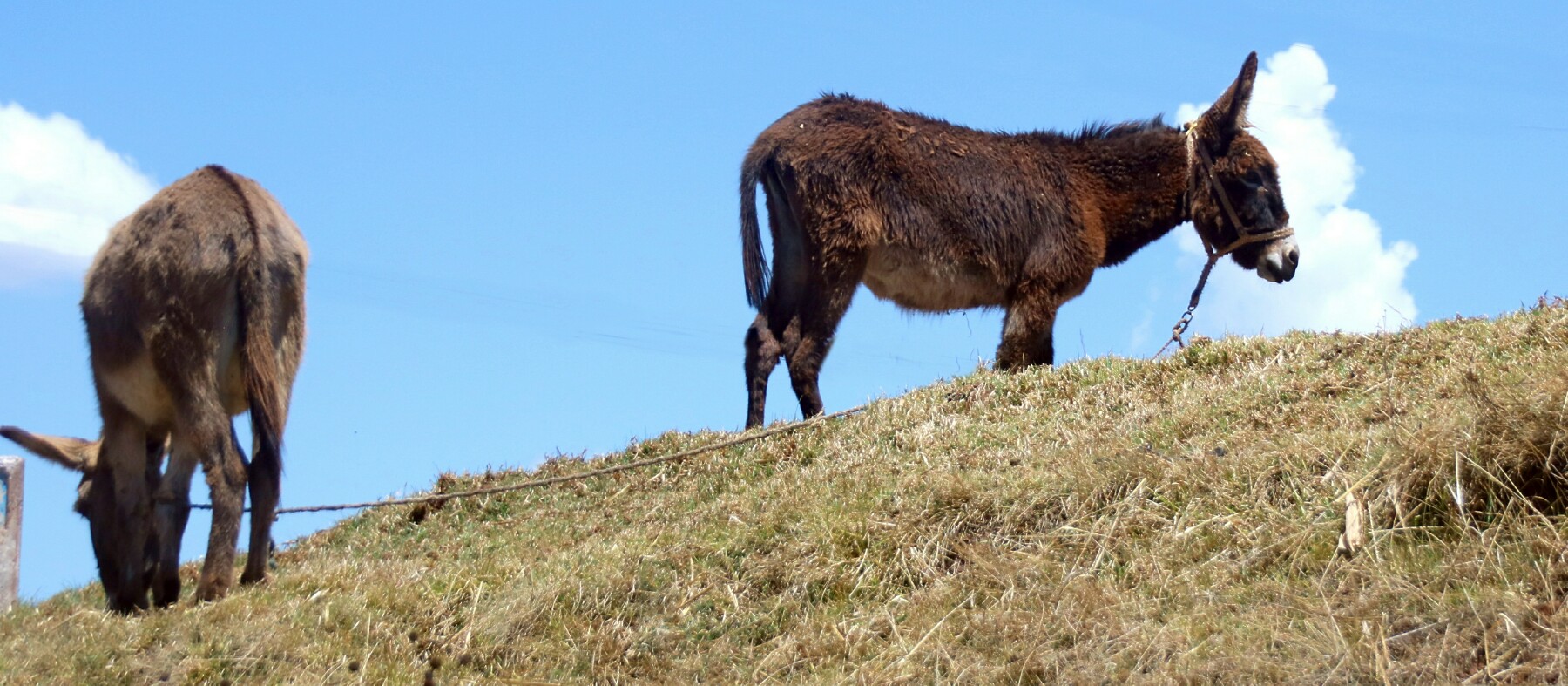
Above: Donkeys graze in the Sacred Valley.
|
|


