Cusco, Peru
September 20, 2026
|
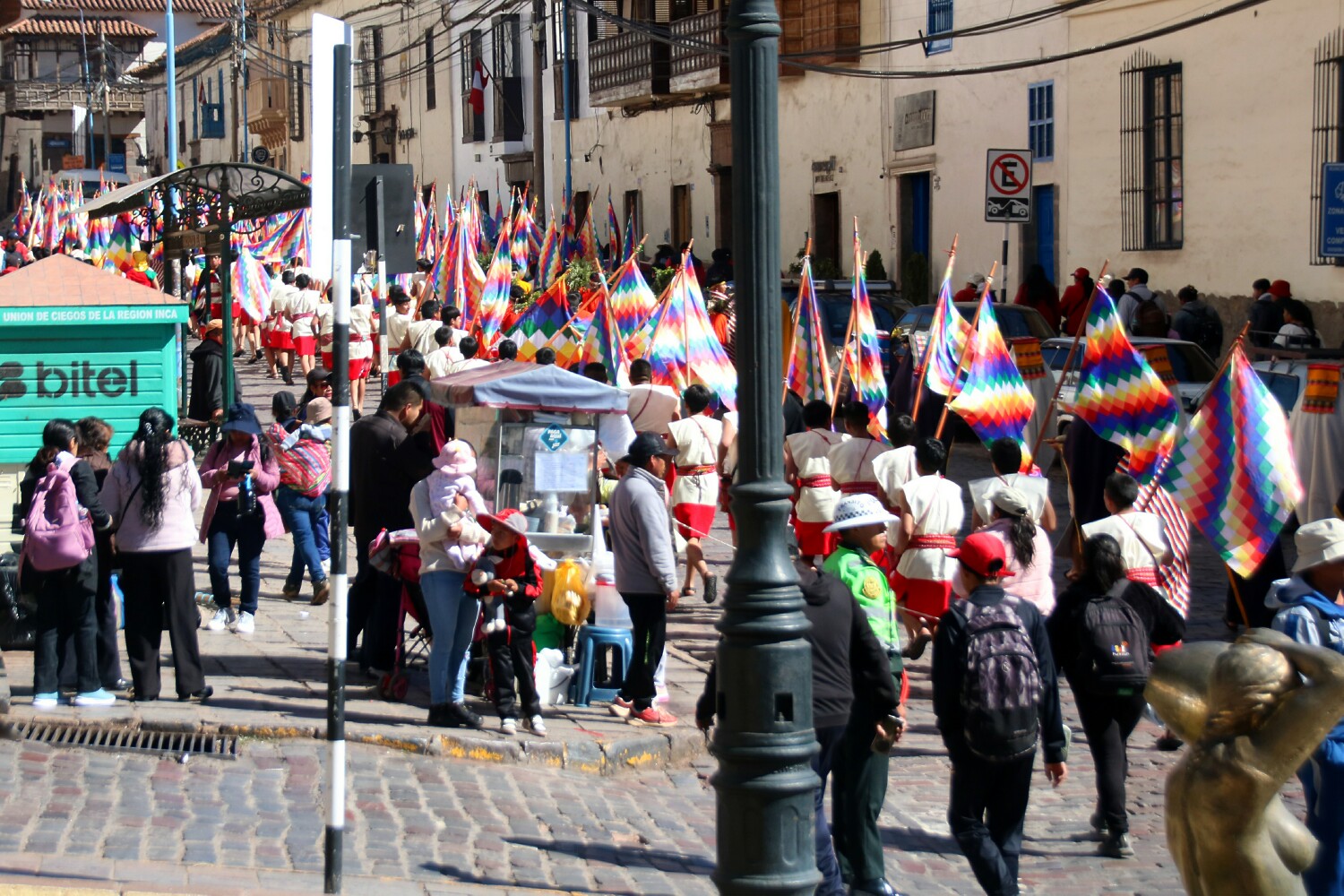
On Day 4, the morning was free to explore the city of Cusco. In the streets near our hotel came the Yo Cusco street parade and cultural gathering, with traditional musicians and
dancers showing Cusco pride and competitions among young men designed to show their manly skills. After that was a walk to the The Plaza de Armas, located in the historic center
of the city. It has been the main public space since before the Spanish arrived here in 1534. For the Incan Empire prior to that, it was the administrative, religious
and cultural center of the imperial capital. It was the place where all kinds of ceremonies were held and the victories of the Inca army were celebrated. Now there's a McDonald's,
Starbucks and a KFC, as well as the churches and convent, and high end stores. On the way back to the hotel, a walk through Plaza Regocijo park.
In the afternoon, the group took a tour around Cusco and surrounding area. First stop after a drive into the mountains to about 3900 metres above sea level (Cusco is normally about
3400 metres above sea level) was Puka Pukara ("red fortress", sometimes Puca Pucara). It is a fort made of large walls, terraces, and staircases
that was part of the defense of Cusco, and the Inca Empire, thought to have been built in the 1400's by Pachacuti (same Incan king who built Machu Picchu). Next stop was at Tikary
Alpace farm, with llama, alpaca and vicuña, and a chance to pet and feed the animals, and not surprisingly, buy lovely and not cheap products made from their fur.
After that we visited the Q'enco Archaeological Complex, one of the largest huacas (holy places) in the Cusco area, based on naturally occurring rock formations. A tunnel runs
inside the huaca with a large gutter on one side, leading to a room containing a ceremonial table with niches on either side. The discovery of many bones within the gutter indicates
this room was the site of ritual sacrifices, and one of the niches inside was used to hold mummies. Close by was the Tambomachay, consisting of a series of aqueducts, canals and
natural springs that were channeled through three waterfalls that still flow today. The function of the site is uncertain: it may have served as a military outpost guarding the
approaches to Cusco, or as a spa resort for the Incan elite, possibly imperial baths, or served a religious function because fountains were found at almost all major Incan temples.
The final stop was at the sprawling Sacsayhuamán, which according to Incan oral history was a fortress said to be built during the reign of Pachacuti and his successors.
Dry stone walls constructed of huge and heavy stones were built on the site, with the workers carefully cutting the boulders to fit them together tightly without mortar. The large
plaza, capable of holding thousands of people, was designed for communal ceremonial activities. Several of the large structures at the site may also have been used during rituals.
Returning down the mountains to Cusco, the group landed at the Church and Convent of Santo Domingo, a 17th-century colonial monastery in the historic centre of Cusco, Peru. It was
built on the foundations of the pre-Hispanic Inca temple of Coricancha, originally constructed under Inka Pachacutec.
The final stop of the tour was the Cathedral Basilica of the Virgin of the Assumption, or the Cusco Cathedral. The Incas built the temple known as Kiswarkancha on the main square
in Cusco. It was the Inca palace of Viracocha, ruler of the Kingdom of Cusco, around a century before the Spanish colonists arrived. The first cathedral in Cusco was the Iglesia del
Triunfo, built in 1539, on the basis of the palace of Viracocha. At present, this church is an auxiliary chapel of the main Cathedral. Between the years 1560 and 1664, the Cathedral
Basilica was built, over 100 years. After that it was dinner time ... fish Ceviche with white corn and sweet potatoes, plus soup and Cusqueña Negra (dark) beer.
BTW, Cusqueña is a locally brewed beer, but owned by ... Molson Coors.
|
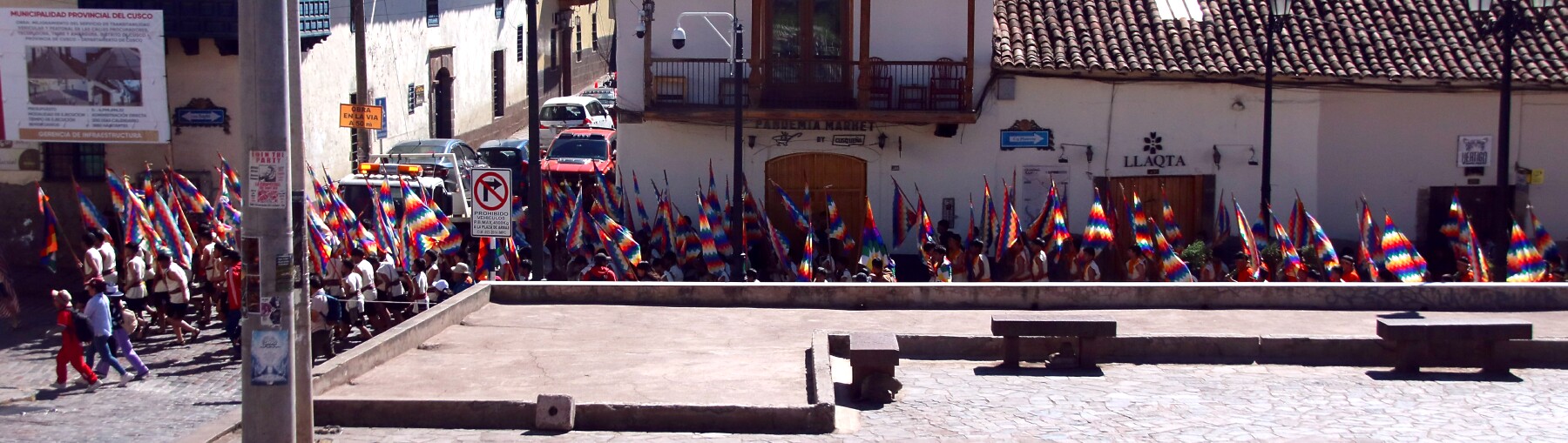
Above: The Yo Cusco parade.
|
|


