Lima, Peru
September 18, 2026
|
Day 2, the tour started in Lima, a sprawling city of almost 12 million people, featuring brutal traffic, and recently named the culinary capital of the world.
Although the history of the city of Lima began with its Spanish foundation in 1535, the territory was occupied by pre-Inca settlements, which were grouped under the
Lordship of Ichma. The Maranga culture and the Lima culture were the ones that predominated. The area was built from 3rd century to 15th century by several civilizations,
and was used until the time the Spanish conquistadors arrived in the 16th century. These cultures were conquered by the Wari Empire during the height of its imperial expansion
around 800 AD. As Wari importance declined, local cultures regained autonomy. Later, in the 15th century, these territories were incorporated into the Inca Empire.
Our group started its tour in the historic area of Lima. We started at the main Plaza de Armas square with impressive Spanish Empire architecture and the quite excellent 16th-century
Cathedral of Lima. Next was a visit to the Casa de Aliaga, the only 16th-century colonial house still owned by the same family, and quite opulent. After a short drive, the group
arrived in the traditional Pueblo Libre district, visiting the Larco Museum, located in a picturesque, restored mansion. The museum features walls and gardens of flowers,
built on a 7th-century pre-Columbian pyramid. It showcases over 45,000 carvings as early as 3000 BC, and an extensive collection of pre-Hispanic gold and silver artifacts,
some of the erotic variety.
After that, most of the group was dropped by the cliffs overlooking the Pacific Ocean in the underground Larcomar Plaza. After the walk back to Miraflores, is was time
for dinner, featuring Octopus Fettuccine and a Pisco Sour.
|
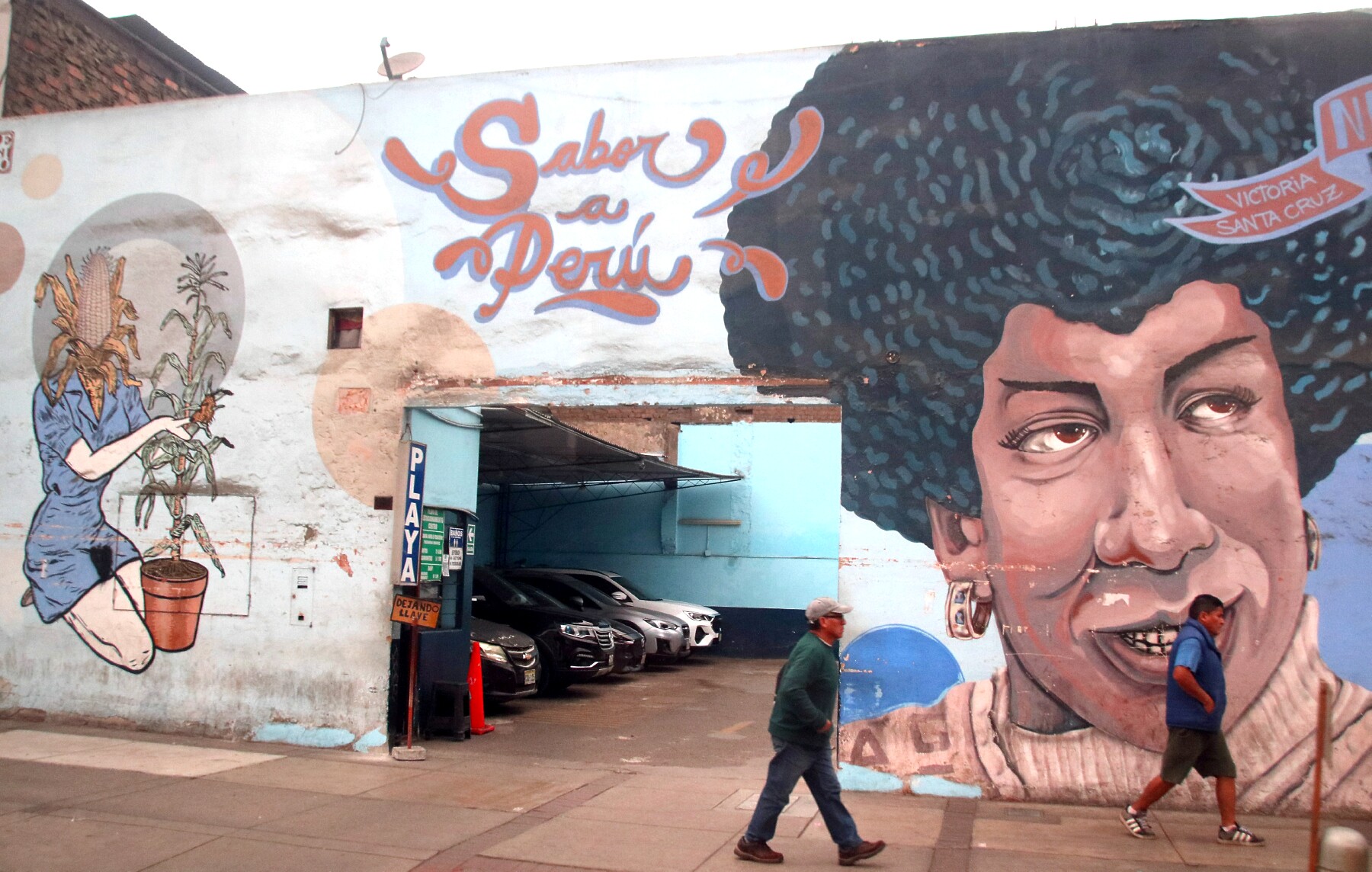
Above: One of many colourful murals scattered all over Lima, this one for a parking garage.
|
|


