Greece
September 17, 2025
|
Delphi was an ancient sacred precinct in central Greece. It was the seat of Pythia, the major oracle who was consulted about important decisions throughout the ancient classical world.
The ancient Greeks considered the centre of the world to be in Delphi, marked by the stone monument known as the Omphalos of Delphi, the Greek word for "navel".
Most of the ruins that survive today date from the most intense period of activity at the site in the sixth century BC, including the fifth Temple of Apollo (there were four
earlier temples to Apollo at the site) that was originally built around the end of the 6th century B.C.E, then reconstructed after a major earthquake in 330 B.C.
The priestesses of Apollo, known as the Pythia, served as the oracle for the Temple of Apollo at Delphi. Greeks and non-Greeks alike would go to the Temple of Apollo at Delphi
from across the Mediterranean and beyond to consult the Pythia on a variety of different topics, ranging from the state level like the establishment of new colonies to the
personal level like marriage, children, and health. The Pythia was typically regarded as the foremost oracle within the Greek world.
The Archaeological Museum of Delphi houses objects found in various places at the site. Principal pieces include a golden bull, the chryselephantine sculpture of Apollo,
Cleobis and Biton statues, bronze shields and helmets, the Sphinx of Naxos, a Caryatid from the Siphnian Treasury, Sculpture of Dionysus,
Statue of the Dancers of Delphi, Statue of Antinous (Emperor Hadrian's boyfriend, who built temples and whole city when Antinous mysteriously died off a boat in the Nile River)
and finally, the Charioteer of Delphi.
|
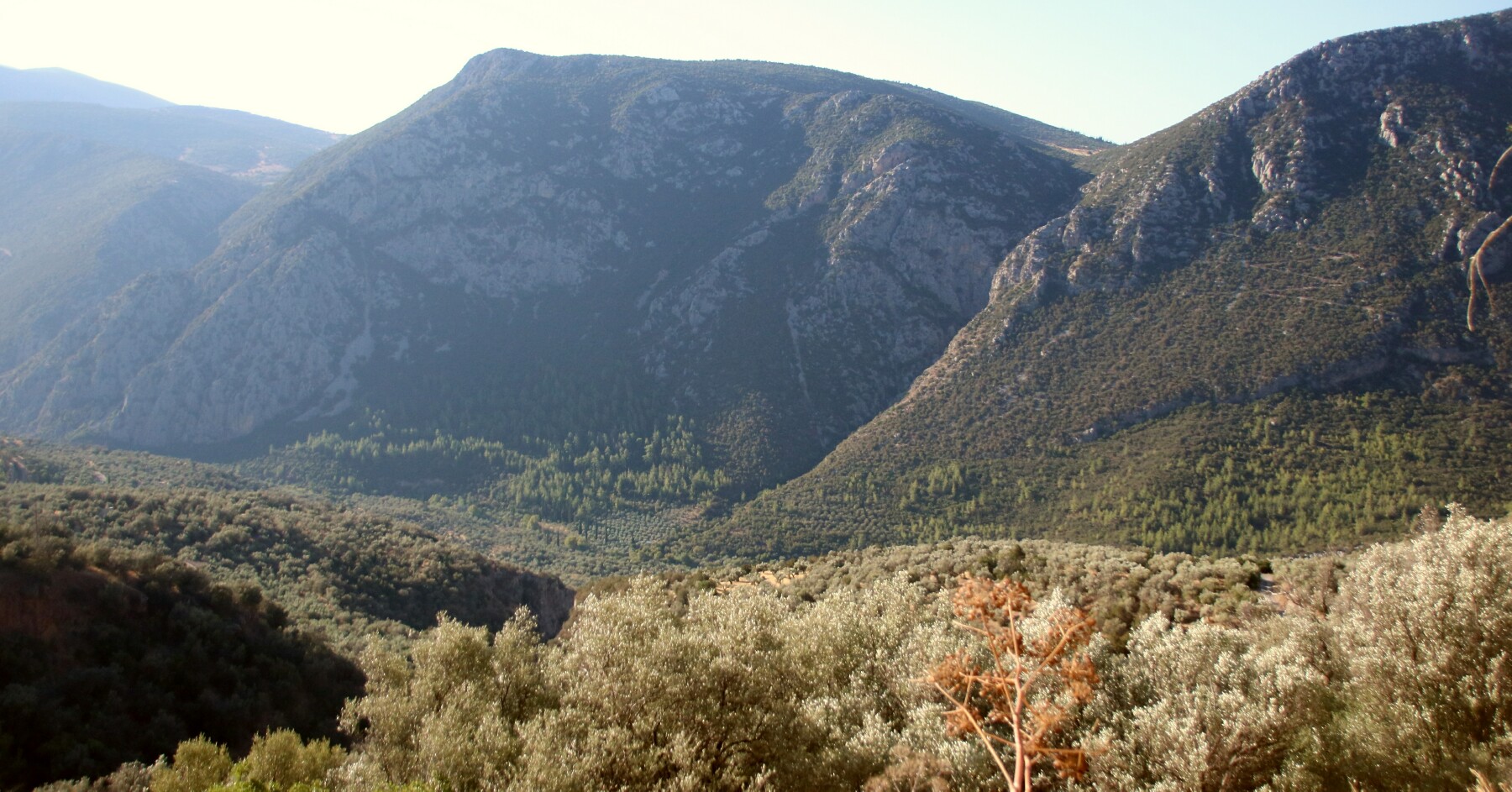
Above: View of the surrounding mountains and valley, from Delphi.

|
|


