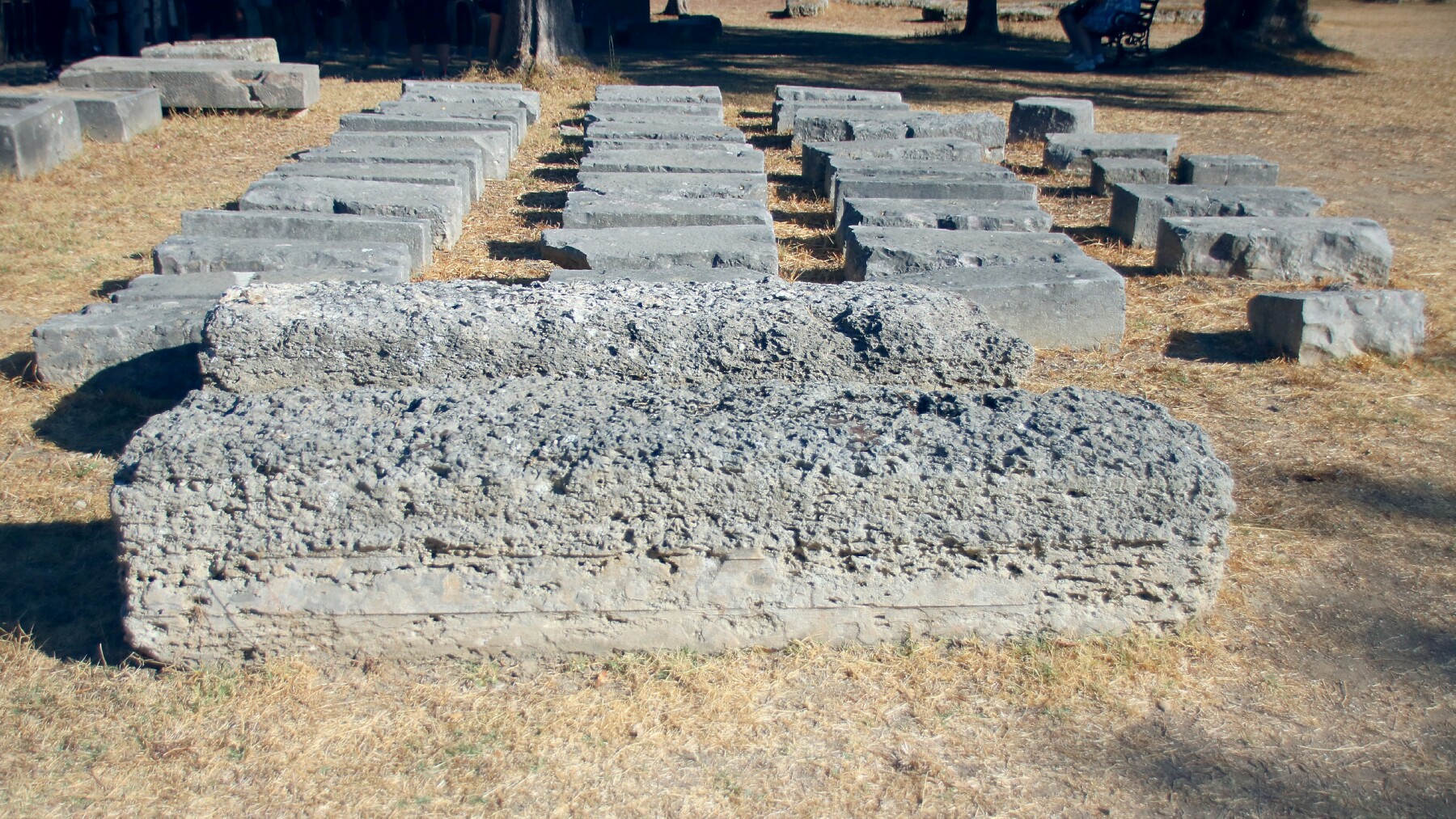
Day 3, our group visited Ancient Olympia. The site was a major religious sanctuary of ancient Greece, where the ancient Olympic Games were held every four years from the 8th century BC
to the 4th century AD. They were restored on a global basis in 1894 in honor of the ideal of peaceful international contention for excellence. The sacred precinct, named the Altis,
was primarily dedicated to Zeus, although other gods were worshipped there. The archaeological site held over 760 significant buildings, and over 70 temples to various Greek gods.
Ruins of many of these survive. Key ones include the Stadium, the Temple of Zeus, the Temple of Hera (Zeus' lovely wife) and the Philippeion, sanctioned by King Phillip II
(the father of ALexander The Great) as a memorial celebrating Philip's victory at the battle of Chaeronea (338 BC).
Olympia was also known for the gigantic ivory and gold statue on a wooden frame of Zeus that was the cult image in his temple, which was named one of the
Seven Wonders of the Ancient World. Statue of Zeus at Olympia was a giant seated figure, about 12.4 m tall, made by the Greek sculptor Phidias around 435 BC at his own sanctuary
in Olympia, and erected in the Temple of Zeus there. The statue was lost and destroyed before the end of the 6th century AD, with conflicting accounts of the date and circumstances.
The Archaeological Museum of Olympia houses numerous objects found in various places in Olympia. The museum houses discoveries from the surrounding area, including objects
produced and used in the area from prehistory to its time under Roman rule. The principal pieces in the museum are Hermes and the Infant Dionysus (attributed to Praxiteles),
some objects from the Temple of Zeus, the Nike of Paionios, and an extensive bronze collection, one of the most significant in the world.
|