Greece
September 15, 2025
|
Day 2, our Wingbuddy group joined a 55-person, 4-day bus tour of some historic parts of mainland Greece.
The group started with a stop at the Corinth Canal, a canal that connects the Gulf of Corinth in the Ionian Sea with the Saronic Gulf in the Aegean Sea. Completed in 1893,
it cuts through the narrow Isthmus of Corinth. It is 6.4 kilometres in length and at 24.6 metres wide at sea level, and impassable for many modern ships.
It is of little economic importance and now mainly a tourist attraction.
The group travelled past ancient Corinth, once a major Greek economic centre, and later rebuilt by the Romans. Ancient Corinth is now just ruins, totally destroyed by an 1858
earthquake of 6.5 magnitude. Driving through the mountains, we stopped at the Ancient Theatre of Epidaurus, built in the 4th century BC, with phenomenal acoustics allowing people
in the top row to hear people talking in normal voices at ground level in the theatre centre. After a quick stop at Nauplion and a cyclopian wall (wall built with such large blocks,
people thought the builders must have been the the huge, mythical cyclops), it was lunch time.
After lunch, the group ventured to the Tomb of Agamemnon, constructed around 1250 BC to house the remains of Mycenaen kings and royalty. It has a huge dome made of blocks and
no mortar, like the Parthenon in Rome that was constructed about 1500 years later. After, we arrived at the ancient city of Mycenae, located in the middle of nowhere. In the second millennium BC, Mycenae was the major centre of Greek
civilization ... a military stronghold which dominated much of southern Greece, Crete, the Cyclades and parts of southwest Anatolia. After, a shopping opportunity at the
Mycenae School of Ceramic Art, and then long drive, at outstanding speeds because the tour was a bit behind schedule, to the night's hotel in Olympia.
|
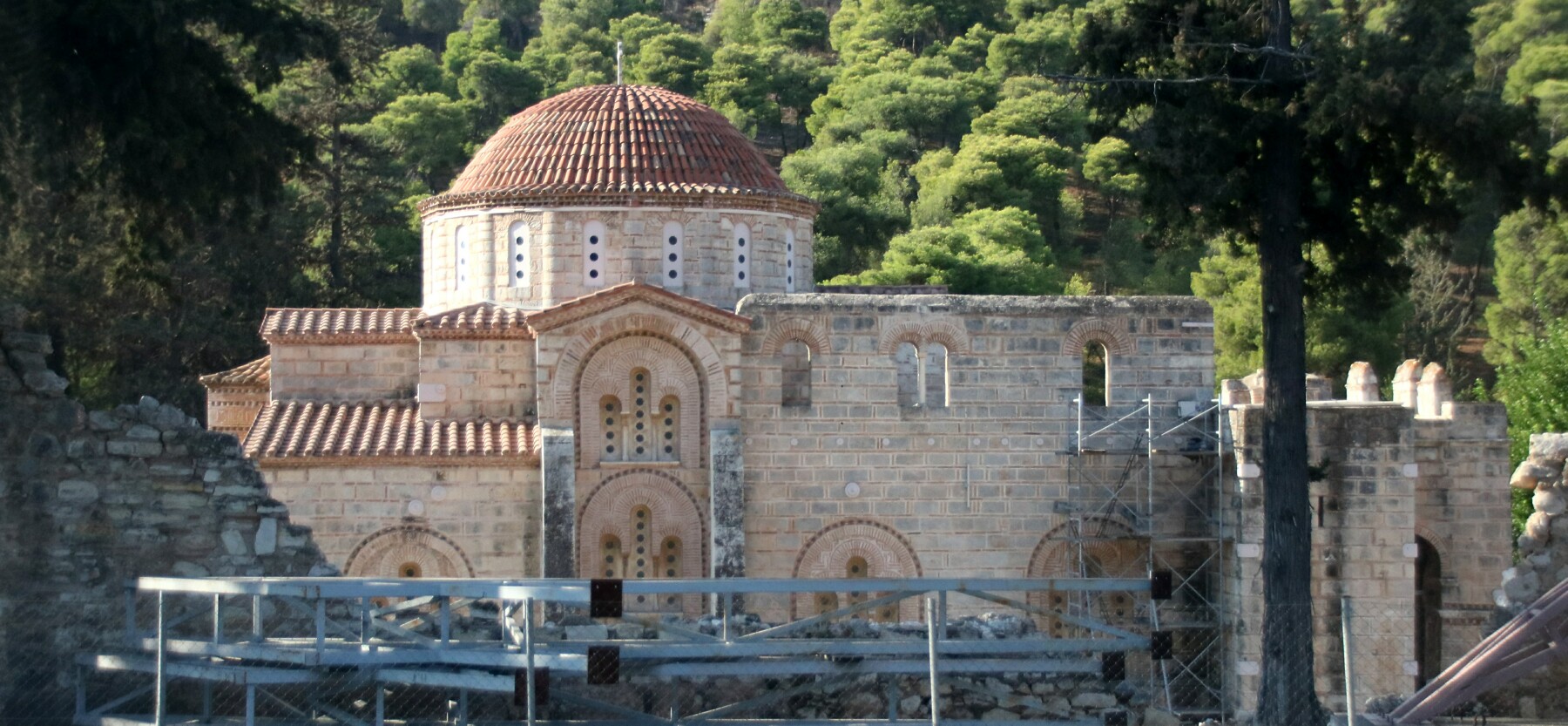
Above: Holy Monastery of Daphni, built in the 11th century AD, east of Athens on the way to Corinth.

|
|


