Day 5, our group left Sarandë and drove up the nearby hill to visit Lëkurësi Castle. This 16th-century Ottoman fortress offered us panoramic views over the Ionian Sea, Sarandë Bay,
the Ksamil Islands, and the Greek island of Corfu. Here's an excellent story ... during communist times, many Albanians wanted to escape Albania to anywhere.
Corfu, part of Greece, was a tempting destination, but very few made it. The problem ... swarms of armed Albanian soldiers around Sarandë with shoot-to-kill orders.
One enterprising Albanian purchased a watermelon and axel grease. He smeared himself with the grease, cut the watermelon in half and hollowed out one side, wearing the watermelon
on his head. At night he floated out, then swam the rest of the way to Corfu, becoming a bit of sensation in the newspapers. Albania soldiers said they just thought the watermelon
rind was just waste floating in the water. Supposedly a number of Albanians successfully escaped this way.
Our group drove along the Albanian Riviera coast, stopping at Ujëvara e
Borshit (Ujvara Restaurant) in the coastal village of Borsh, a unique dining spot built directly over a natural spring, where mountain streams go through cascading waterfalls right
inside the restaurant.
Next, it was on to the Bay of Vlorë and the Porto Palermo Fortress, a French engineer-designed triangular fortress built in the early 19th century by Ali Pasha of Tepelenë,
the powerful Ottoman-Albanian ruler. In the same bay, in the mid-1950s the Pashaliman Naval Base there served as the Soviet Union's strategic foothold in the Mediterranean.,
The Soviets kept 12 submarines there, but when the Albanians felt out with the Sovitet Union in 1961, they only gave back 8 submarines, and kept 4 for themselves, which did not go
over well, but the four submarines eventually deteriorated without proper maintenance and replacemnt parts. Built later by the communist regime, the Porto Palermo Bunker features a massive 650-meter-long, 12-meter-high bunker carved entirely into solid rock designed to withstand a
nuclear strike. It was actually constructed in 1969 to house Chinese-made missile and torpedo boats, when Albania aligned with the Chinese after the 1961 divorce from Russia. The
tunnel and bay is still used by Albania as a military base.
Our group moved from Porto Palermo through the Llogara Tunnel, a 6 km roadway cutting through the Ceraunian Mountains, and ended up in Vlorë, the city where independence was
signed and declared in 1912. Enjoyed a walk on the boardwalk as the sun was going down behind the clouds, and finally, a crepe and the thickest chocolat ever.
|
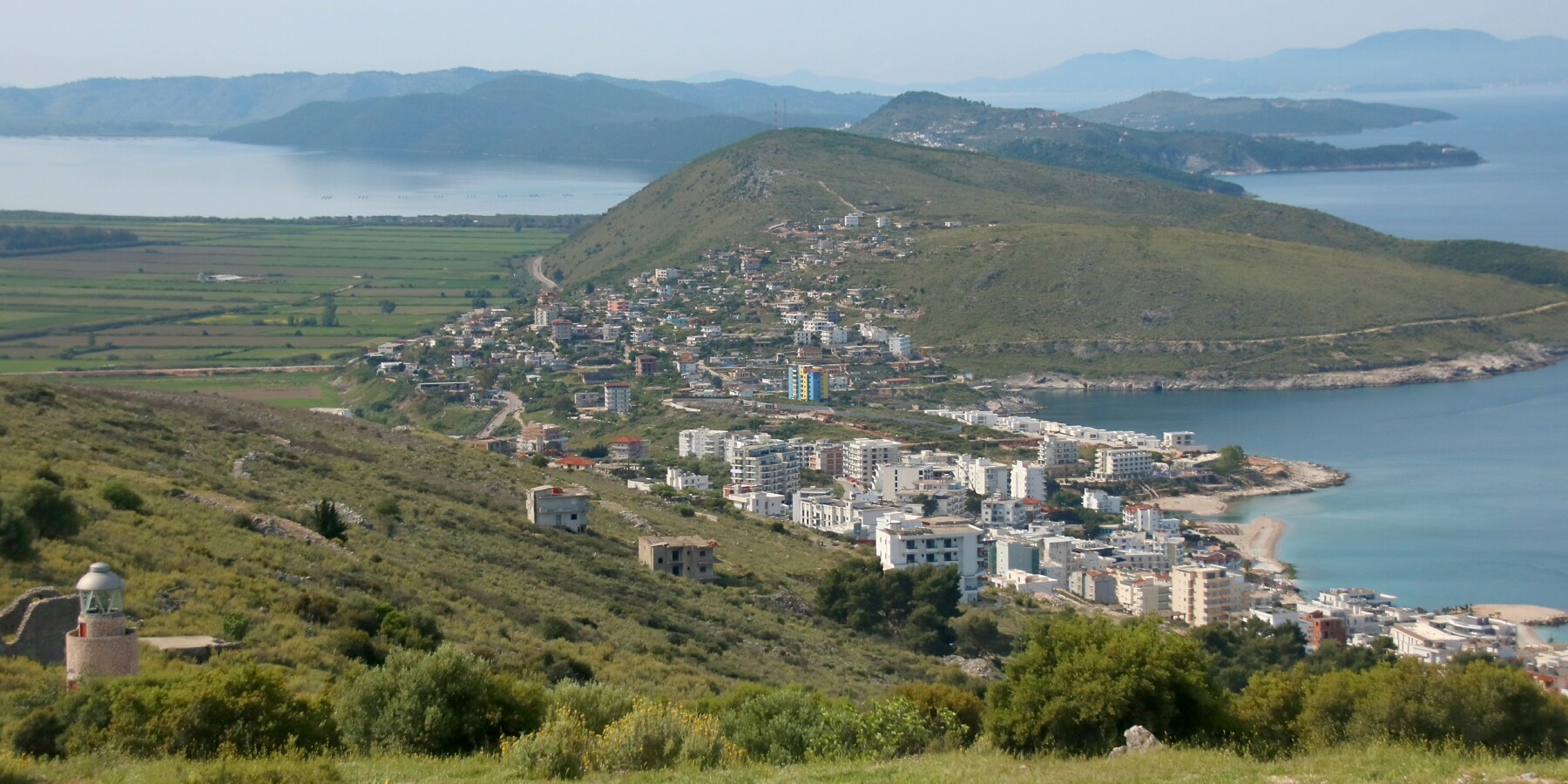
Above: The city of Sarandë, seen from Lëkurësi Castle, a 16th century Ottoman fortress, and the Ksamil Islands in the background.
|
|


