Day 3, our group returned to Berat Castle to visit the Onufri Iconographic Museum, housed inside the historic Church of the Dormition of St. Mary, with over 100 icons, some from
Albania's most revered iconographer Onufri and ones from other artists. Then we visited St. Mary of Blachernae Church, a Byzantine orthodox church dating from the 13th century,
with frescoes mostly done by Onufri in the 16th century. Right next door is St. Nicolas Church, and down the hill nearby is the Church of St. Michael, beautiful looking on the
outside, badly neglected on the inside.
After leaving Berat Castle, the van drove along the intense turquoise blue Vjosa River. We arrived in the mountain town of Gjirokastër, with stone roadsa and Ottoman era architecture.
It was probably the most touristy of all the places we visited, although the boutique Hotel Praga was in a wood and stone building that has been a hotel since 1826. After a nice
lunch at a restaurant featuring wood-fired stove cuisine, and after strolling through the old bazaar area, we trekked up to Gjirokastër Fortress, an imposing 12th century
Byzantine fortress. It possesses five towers, including a clock tower at one end, and has a stage to host the National Folk Festival. The Ottomans took over in the early 1500's.
Albanian legend has it that Princess Argjiro lived in the 15th century and jumped off Gjirokastër Fortress, along with her child, so as to avoid being captured by the Ottomans.
Legend has it that the child lived because the Princess' body cushioned the blow. Unlike other myths, Princess Argjiro was a real historical person who lived in the fortress
and she did kill herself when the Ottomans breached the castle.
Extensive renovations and a westward addition was added by Ali Pasha of Tepelene after 1812. An American fighter jet crashed in Albania, the pilot questionned for days, but eventually
released back to the U.S. ... the plane is on display inside the fortress. The government of King Zog expanded the castle prison in 1932. Communist dictator
Enver Hoxha, who was born in Gjirokastër, added his own prison cells, and kept many political prisoners there, including some of his childhood neighbours. Hoxha's regime executed
numerous prisoners on the roof of the fortress, so those in the community could hear, and sometimes see, the gunshots killing their fellow citizens. Our guide's grandfather spent
13 years in many prisons in Albania just for being caught saying something negative about the communist justice system, but survived and eventually was released and with his wife
quickly produced our guide's mother.
After leaving the fortress, we visited Skënduli House, an Ottoman era mansion built in the 1700's and partially rebuilt in 1827. It was taken over by the communists sometime after
1945, but returned to the original family in 1991, to owner Nasip Skënduli who runs the house with his daughter for visitors. It boasts 64 windows, 40 doors, 12 rooms and 9 fireplaces,
with most rooms in their original state, with original beds and fireplace hoods.
Our guide Florent highlighted that there were several "toilets" in various rooms
off of bedrooms and other rooms, which are basically holes in the floor with pipes taking the deposits below. He compared it to the opulent Versailles Palace built around the same
time that had no toilets. I did not mention that there was a full throne toilet that could be sat on, on the second floor of the West House in Akrotiri, Santorini, with pipes going
down to a sewer system that ran through the entire town. That was installed prior to 1600 BC. But it was interesting to see how the well-to-do Ottomans lived.
|
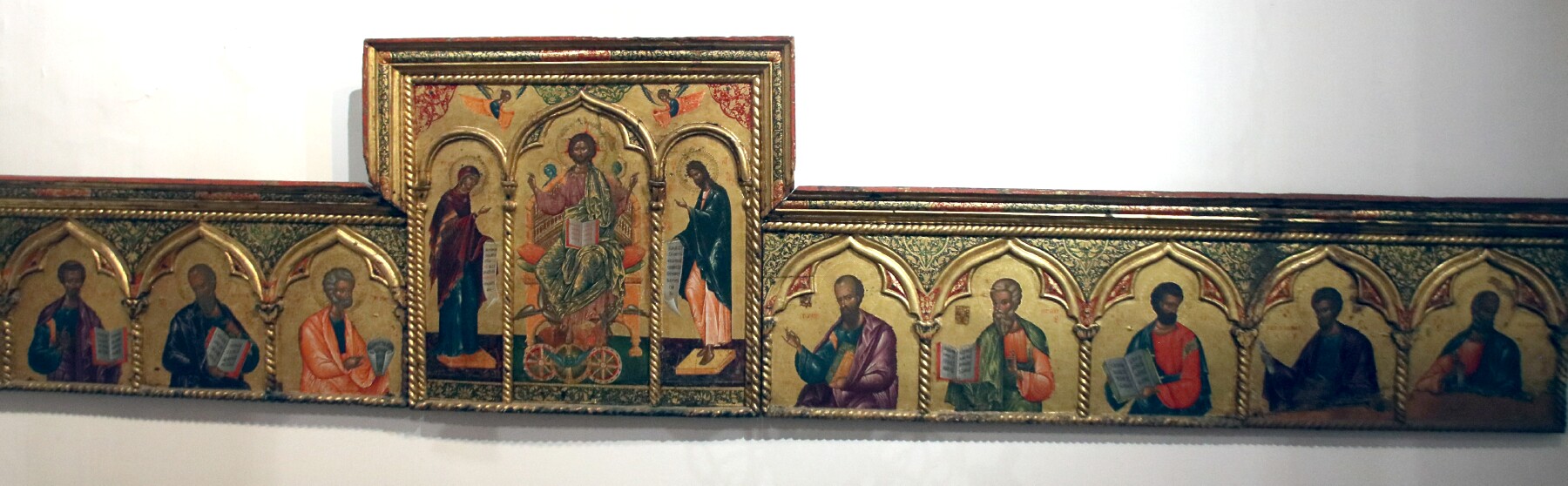
Above: A multi-paneled set of icons from iconographer Onufri. He was a priest and archbishop, trained in painting in Venice, from the 16th century,
who painted numerous icons and frescoes, including this one.
|
|


